[JV]
Part 2: a transformer trained from scratch
Trained a 162K-parameter character-level transformer end to end on Tensor: embeddings, causal self-attention, layer norm, a feedforward block, cross-entropy loss, and a from-scratch Adam optimizer. Zero PyTorch in the model itself.
- Attention and layer norm needed only four new primitives on top of the existing tensor engine:
log,swapaxes,embedding, andlayer_norm - Every
_backwardclosure captures its own output node, so every node in the graph is a reference cycle; a training loop that discards a full graph every step leaks memory fast enough to crash the process - The full architecture was gradient-checked end to end against an independent PyTorch reimplementation, not just op by op
A separate autograd-free inference path with a KV cache, benchmarked against this training-time implementation.
The engine already supports batched tensors, broadcasting, and softmax. This uses it to train an actual transformer: embeddings, causal self-attention, layer norm, a feedforward block, cross-entropy loss, and Adam, all implemented from the same local-gradient-rule pattern as everything else in it. It trains on character-level Shakespeare and produces gradients that match PyTorch's to 1e-6.
Four new primitives
Attention and layer norm need four additions to Tensor beyond matmul and softmax.
log is the same shape as exp: out = log(x), ∂out/∂x = 1/x.
def log(self):
    out = Tensor(np.log(self.data), (self,), "log")
    def _backward():
        self.grad += out.grad / self.data
    out._backward = _backward
    return out
swapaxes(axis1, axis2) computes Kᵀ for attention scores without leaving the graph. Swapping two axes is its own inverse, so the backward rule swaps the upstream gradient back the same way:
def swapaxes(self, axis1, axis2):
    out = Tensor(np.swapaxes(self.data, axis1, axis2), (self,), "swapaxes")
    def _backward():
        self.grad += np.swapaxes(out.grad, axis1, axis2)
    out._backward = _backward
    return out
embedding(indices) is a weight matrix E of shape (vocab_size, embed_dim), indexed by integer token ids. The forward pass is a gather, E[indices]. The backward pass is a scatter-add: every row of E that was looked up gets the upstream gradient added into it, and a row indexed k times accumulates k separate contributions.
def _backward():
    grad = np.zeros_like(self.data)
    np.add.at(grad, indices, out.grad)   # scatter-add, not grad[indices] += out.grad
    self.grad += grad
np.add.at matters here specifically because plain fancy-index assignment silently drops all but the last write when an index repeats, and common characters like ' ' or 'e' repeat constantly within a single text batch. This is the same principle as _unbroadcast for broadcasting (a value used more than once accumulates gradient from every use), just with data-dependent reuse instead of a fixed broadcast shape.
layer_norm(gamma, beta, eps, axis) normalizes each token's feature vector to zero mean and unit variance, then applies a learned scale and shift:
μ and σ² are functions of every element of x, so nudging one element perturbs the normalization of every other element too, and deriving that Jacobian by hand is genuinely involved. Instead layer_norm is written purely as a composition of already gradient-checked primitives:
def layer_norm(self, gamma, beta, eps=1e-5, axis=-1):
    mu = self.mean(axis=axis, keepdims=True)
    xmu = self - mu
    var = (xmu ** 2).mean(axis=axis, keepdims=True)
    xhat = xmu / (var + eps) ** 0.5
    return xhat * gamma + beta
Every op here (mean, sub, pow, truediv, mul, add) already has a correct backward rule, so the composed backward rule is correct automatically, the same pattern used for sub/truediv/mean throughout the engine. All four additions are gradient-checked against PyTorch, including a repeated-index case for embedding that specifically exercises the scatter-add path.
Self-attention
Single-head scaled dot-product self-attention, embedding dimension 64, 3 layers:
Every operation here (matmul, swapaxes, softmax, elementwise add) already exists and is gradient-checked. The causal mask is a constant (T, T) matrix, 0 on and below the diagonal and -inf strictly above it, added to the scores before softmax. Subtracting the row max before exponentiating, already built into softmax, means exp(-inf - max) = 0 exactly, so masked positions get zero attention weight with no special-casing required.
Transformer block, output head, and cross-entropy
A pre-norm residual block:
with feedforward(x) = relu(x W1 + b1) W2 + b2. Three of these blocks, a final layer_norm, and a linear projection to vocabulary size. Cross-entropy loss is softmax followed by a gather of the target-token probability and a log/mean reduction:
def cross_entropy_loss(logits, targets):
    probs = logits.softmax(axis=-1)
    one_hot = Tensor(np.eye(logits.shape[-1])[targets])   # constant, not a parameter
    target_probs = (probs * one_hot).sum(axis=-1)
    return -((target_probs + 1e-12).log()).mean()
The gather is a one-hot multiply-and-sum rather than a new indexing primitive, so it reuses mul, sum, and log, all already verified. The 1e-12 floor guards against log(0) = -inf poisoning the loss with a nan gradient; with float64 throughout, probabilities never actually underflow to zero at this scale, but the guard costs nothing.
Adam, by hand
The optimizer operates directly on .data/.grad NumPy arrays rather than through the Tensor graph, since the update itself isn't part of the differentiable computation:
m is a decaying average of the gradient, v a decaying average of the squared gradient, and the bias-correction terms compensate for m and v starting at zero. Tested against torch.optim.Adam on the same toy quadratic for 20 steps: parameters match to 1e-8 at every step, not just at the end.
Verifying correctness end to end
Beyond checking each new primitive individually, the entire architecture is reimplemented a second time in raw PyTorch, with weights copied directly from the trained model, and both forward and backward passes are compared: every attention projection, every layer norm scale and shift, every feedforward weight, the embeddings, and the output head, across both transformer blocks. Forward output and every parameter's gradient match to 1e-6. This checks the full attention plus layer norm plus feedforward plus cross-entropy stack as one composition, not each op in isolation.
A real bug: reference cycles and unbounded memory
The first full training run crashed. Every _backward closure reads out.grad, which means it closes over out, so every Tensor node created during a forward pass holds a reference cycle back to itself (out._backward → closure → out). Building one graph and calling .backward() once leaves a handful of harmless leaked cycles, easy to miss. A training loop is different. It builds and discards a full attention-stack graph (~130 nodes) every step, and Python's cyclic garbage collector couldn't reclaim them fast enough. Memory grew to tens of gigabytes within a few hundred steps, and the OS killed the process.
The fix, in backward(): once every node's _backward() has run and all gradients are computed, the graph is disposable, since nothing calls into it again. backward() now walks the topological order a second time and explicitly clears _backward and _prev on every node, breaking the cycle so plain refcounting frees the graph immediately instead of waiting on a GC sweep:
for v in topo:
    v._backward = lambda: None
    v._prev = set()
Peak resident memory during a 300-step run went from unbounded growth to a flat ~1.75GB from step 50 onward. The same latent bug existed in the original scalar engine and got the same fix, even though it never manifested there: those workloads are too small to expose it. It's the kind of bug that's invisible at unit-test scale and only shows up once the thing actually runs for real.
Result: char-level Shakespeare
Trained on the ~1.1MB Tiny Shakespeare corpus, 65-character vocabulary, TinyTransformer(vocab_size=65, block_size=64, embed_dim=64, n_layers=3, hidden_dim=256), 161,985 parameters, Adam at lr=3e-4, batch size 32, 4000 steps:
step 0:    train 4.2912, val 4.2927   (random-guess baseline: ln(65) ≈ 4.174)
step 1000: train 2.1483, val 2.1942
step 2000: train 1.8728, val 1.9883
step 3000: train 1.7609, val 1.8816
step 3999: train 1.6667, val 1.8447
4000 steps took 1022.9s on CPU (255.7 ms/step average, including periodic eval passes)
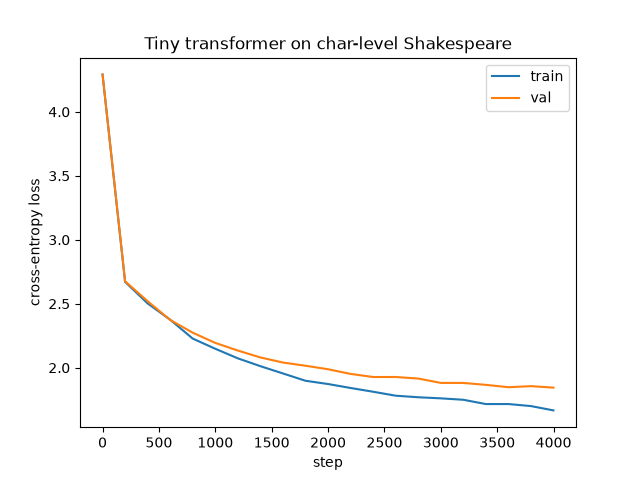
Train and validation loss track closely throughout, with no overfitting at this scale. Sampling from the model before and after training:
before training (random weights):
S$;3;xRFIJIyhJqW3I$$epfYV.Ix.Bv,KkI&h$heP
giYxU$KddpI.c
l'.$F$K;.UFF$&WcF'UK!'DUpe.xVIZPdcppU&IPXcMwMUcFK?wLCGKFHBvc:f,GhUyBLvSoqyFFP$xv!xFebDUYyGh.ZuI'vnPsF,U'kJvU,hU.T .$xPPOG!UyGfUnY$cvUFX$v?PIUIII,$IUU vUfLqeegXk'-IKVUIKgeFF,KKYU$IFexuIPUKUKpeKpeKkUUpooXmhKP

after training (4000 steps):
BROKE:
In am the victorgoe. Comeos the awail.

First this I Rome fall before to pents but he ears.

JULIET:
But
No, Biture, and hath way hour may willow as you with fing to live,
And that and I have take me day mother's thangs entend my not melsand
To me in lord prace house both gently your at as k
Not coherent English, but real structure appears with none of it hand-coded: character names in caps followed by a colon (BROKE:, JULIET:), blank lines between speaker turns, real English words (before, hath, mother's, gently), and plausible cadence, from a 162K-parameter model trained for about 17 minutes on a laptop CPU, on gradients computed entirely by the engine in this repo.
What I learned
- The four new ops attention and layer norm required (
log,swapaxes,embedding,layer_norm) are all instances of the same local-gradient-rule pattern as everything before them; nothing about attention itself needed a new differentiation idea, only more bookkeeping. - An autodiff engine whose backward closures capture their own output node creates a reference cycle in every node it produces, and this only becomes visible at real training-loop scale, not in unit tests that build one graph and call
.backward()once. - Gradient-checking an entire architecture end to end, against an independently reimplemented reference, catches integration errors that per-primitive checks cannot.
What's next
A separate, autograd-free inference path that loads the weights trained here and runs a plain NumPy forward pass with no graph tracking, plus a KV cache benchmarked against it. Training-time code needs the graph to differentiate; inference doesn't, so removing it is a legitimate speed win with no accuracy cost.